
Backyard Learning Center
Learn practical backyard skills one project at a time through beginner-friendly articles, seasonal tips, and step-by-step guides that help you build, grow, raise, and thrive.
Why Isn’t My Compost Working?
7 Common Problems and Easy Fixes
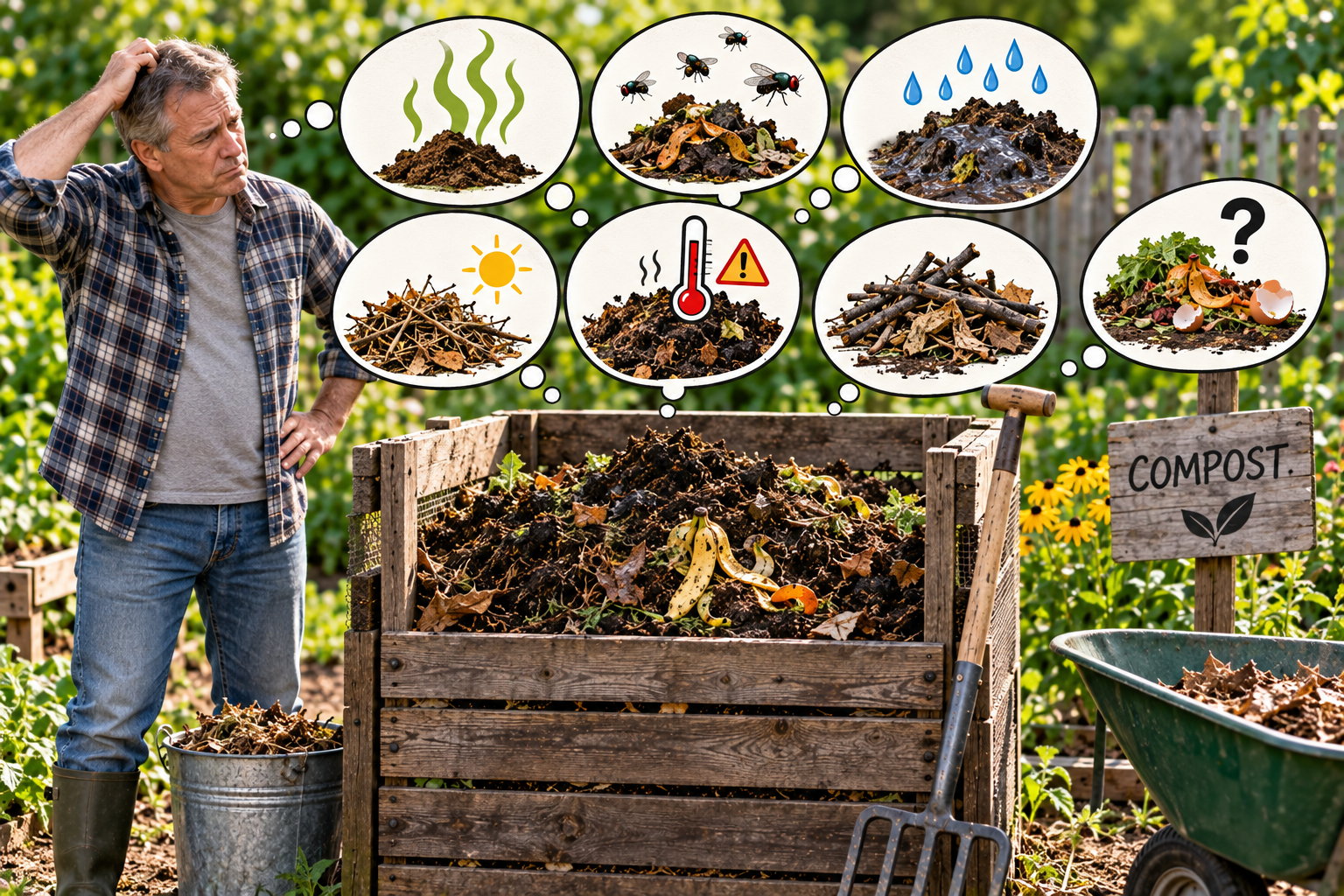
You started composting with the best intentions.
Kitchen scraps went in. Leaves went in. Coffee grounds went in. You occasionally gave everything a turn.
And now?
Maybe nothing seems to be happening.
Or perhaps something is happening, but judging by the smell coming from the backyard, you’re fairly certain it isn’t good.
The good news is that compost piles are surprisingly forgiving. When something goes wrong, you usually don’t need to empty the bin and start over.
Your pile probably needs one small adjustment.
Here are seven of the most common composting problems and how to fix them.
Problem #1: My Compost Smells Terrible
Healthy compost shouldn’t smell like garbage.
A properly working pile usually has a mild, earthy smell. If yours smells rotten, sour, or otherwise capable of clearing the patio, the pile may contain too much nitrogen-rich material, too much moisture, or not enough oxygen.
This commonly happens when large amounts of food scraps or fresh grass clippings are added without enough dry material.
The Easy Fix
Add browns such as:
- Dry leaves
- Shredded cardboard
- Straw
- Plain shredded paper
- Other dry plant material
Then turn or mix the pile to introduce oxygen.
If the pile is extremely wet, add enough dry browns to absorb some of that excess moisture.
In many cases, that’s all it takes.
Smelly compost is usually compost asking for browns and air.
Problem #2: Nothing Is Breaking Down
You’ve been adding material for weeks, but everything looks suspiciously similar to the day you put it in.
There’s the cardboard.
There’s the leaves.
And apparently that carrot peel has decided to become a permanent resident.
A slow pile can have several causes, but three of the most common are:
Not enough moisture.
Not enough greens.
Pieces that are too large.
The Easy Fix
First, check the moisture.
Grab a handful from inside the pile. It should be approximately as damp as a wrung-out sponge.
If it’s dry, add water.
Next, look at what you’ve been composting. If the pile consists mostly of dry leaves, cardboard, straw, and other browns, add some nitrogen-rich greens such as kitchen scraps, coffee grounds, fresh garden material, or grass clippings.
Finally, break larger materials into smaller pieces when practical.
A whole branch takes a long time to decompose.
Smaller pieces give microorganisms more surface area to attack.
You don’t need to chop everything into tiny bits. Just remember:
Smaller materials generally break down faster.
Problem #3: My Compost Is Too Wet
You reach into the pile and everything is soggy.
Maybe water runs out when you squeeze a handful.
That’s too wet.
Excess moisture fills the air spaces inside the compost, reducing the oxygen available to the microorganisms responsible for decomposition.
And once oxygen disappears, unpleasant odors often aren’t far behind.
The Easy Fix
Add dry browns.
Shredded cardboard and dry leaves are especially useful because they absorb moisture while adding carbon.
Mix them throughout the wet material rather than simply tossing them on top.
Then turn the pile to introduce air.
If rain is causing the problem, consider covering the top of the compost while still allowing ventilation.
You’re aiming for damp, not soaked.
Think wrung-out sponge, not backyard swamp.
Problem #4: My Compost Is Too Dry
This is the opposite problem.
You turn the pile and find dry leaves, brittle cardboard, and materials that don’t appear to be changing very much.
Microorganisms need water.
Without sufficient moisture, decomposition slows considerably.
The Easy Fix
Add water gradually while mixing the pile.
Don’t simply blast the top with a garden hose and call it finished. The surface may become soaked while the center remains dry.
Add some water.
Turn.
Add a little more.
Turn again.
Stop when the materials are evenly damp.
If your pile dries out repeatedly during hot weather, covering it can help retain moisture.
And remember the squeeze test.
Wrung-out sponge.
If you remember that description, you can solve a surprising number of composting problems without owning a single moisture meter.
Problem #5: My Compost Pile Isn’t Heating Up
First, don’t panic.
Not every compost pile needs to become hot.
Cold composting works too. It simply takes longer.
But if you’re intentionally trying to create a hot compost pile and the temperature isn’t rising, something may be missing.
The pile could be:
- Too small
- Too dry
- Short on nitrogen-rich greens
- Poorly mixed
- Lacking sufficient microbial activity
The Easy Fix
Check the basics.
Is the pile moist?
Does it contain both greens and browns?
Is there enough material to retain heat?
Have the ingredients been mixed together?
Adding nitrogen-rich material and moisture, followed by a good turning, may help get microbial activity going again.
Temperature is useful information, but don’t make the thermometer the boss of your compost pile.
Decomposition is the goal.
Heat is one way of getting there.
Problem #6: Flies or Animals Are Visiting My Compost
You lift the lid and discover you’ve apparently opened a neighborhood restaurant.
Flies are hovering.
Something has been digging around the bin.
And the local raccoon may have left a five-star review.
Exposed food scraps are often the problem.
The Easy Fix
Whenever you add kitchen scraps, cover them with browns.
Dry leaves, shredded cardboard, straw, or other carbon-rich materials help hide food scraps and reduce odors that attract unwanted visitors.
You can also bury fresh kitchen scraps slightly inside the existing compost instead of leaving them sitting on top.
Avoid adding materials that are especially attractive to animals, including:
- Meat
- Fish
- Dairy
- Fats
- Grease
- Oils
If animals continue getting into the pile, you may need a more secure bin or enclosure.
Your compost should feed your garden.
It doesn’t need to feed every raccoon in the county.
Problem #7: My Finished Compost Still Has Pieces in It
You waited.
You turned.
You watered.
And finally, you’ve got beautiful dark compost.
Except there are still a few twigs, pieces of cardboard, avocado skins, or other recognizable materials mixed throughout it.
Did something go wrong?
No.
Different materials decompose at different rates.
The Easy Fix
Remove the larger unfinished pieces and toss them into your next compost batch.
If you want especially fine compost for potting mixes or certain garden applications, you can screen the finished material.
The smaller compost passes through.
The larger pieces go back into the pile for another round.
Consider them composting repeat customers.
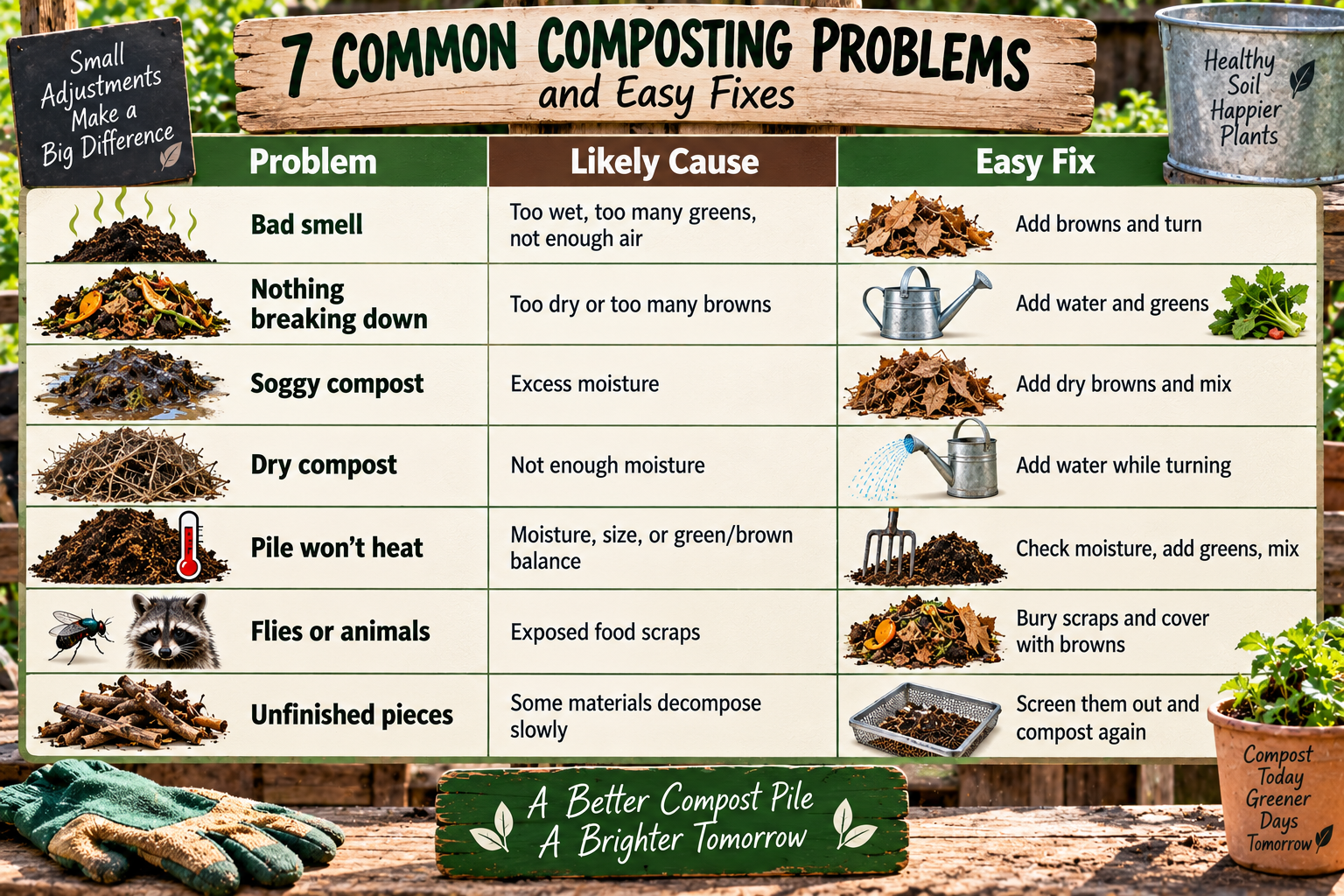
Learn to Read Your Compost
One of the most useful skills you can develop isn’t memorizing composting formulas.
It’s learning to recognize what your pile is telling you.
It smells? Check moisture, browns, and oxygen.
It’s dry? Add water.
It’s soggy? Add dry material.
Nothing is happening? Check your greens, moisture, and ingredient size.
Animals are visiting? Cover those food scraps.
Once you start recognizing these clues, troubleshooting becomes much easier.
And here’s perhaps the most important thing for beginners to remember:
You probably haven’t ruined your compost.
A neglected pile doesn’t suddenly become worthless.
A wet pile can be dried.
A dry pile can be watered.
A smelly pile can be corrected.
A slow pile can be encouraged.
Composting isn’t about creating perfect conditions every day. It’s about making occasional adjustments while billions of microorganisms quietly handle most of the work.
And unlike many household projects, if you ignore your compost for a couple of weeks, it won’t send you an overdue notice.
It’ll just sit there.
Composting. 🌱
Ready to Grow More with Less Work?
Composting Made Easy expands on each of these topics with clear, step-by-step guidance designed specifically for beginners. From choosing the right composting method and knowing what to add to balancing greens and browns, managing moisture, avoiding common problems, and knowing when your compost is ready, the book provides practical instruction to help you turn everyday scraps and yard waste into rich, healthy compost with confidence. 🌱

More Composting Articles
If you found this article helpful, these beginner guides are a great next step:
Get Your FREE Backyard Starter Toolkit
Download our free Backyard Starter Toolkit, packed with printable planners, checklists, and beginner resources to help you build, grow, raise, and thrive.
About the Author
Steve McChesney is the founder of Backyard Living Books and has spent decades helping homeowners build, grow, raise, and preserve more from their own backyards. Through practical, beginner-friendly guides, he encourages people to tackle one backyard project at a time and enjoy the satisfaction that comes with learning new skills.